The 5-Second Rule: Capturing Attention Instantly at Exhibitions
You’ve spent months on logistics, flown in your top sales team, and invested a significant portion of your marketing budget into a single floor space. But as the doors open, you realize the brutal truth: You have exactly five seconds to keep a visitor from becoming a "passerby."
In the high-decibel, high-glare environment of an exhibition, attention is the only currency that matters. Most stalls don’t fail because their product is bad; they fail because they are invisible. If a visitor can't figure out who you are and why they should care in the time it takes to sneeze, they’re already halfway to your competitor’s booth.
Here is how to win the battle for the first five seconds and turn a wandering crowd into high-value leads.
1. Why 5 Seconds is the Only Timeline That Matters
The average trade show attendee is hit with thousands of visual stimuli per hour. To survive, the human brain enters a "filter mode." Visitors aren't looking for every booth; they are looking for reasons to ignore you.
- Attention Scarcity: In a sea of 500 exhibitors, the brain prioritizes contrast and clarity.
- The "Aisle-Trudge": Physical fatigue sets in fast. Visitors become more selective about where they expend their remaining energy.
- First Impressions are Sticky: If your booth looks disorganized or generic, that "mental label" stays with your brand long after the show ends.
2. The Anatomy of a 5-Second Stop
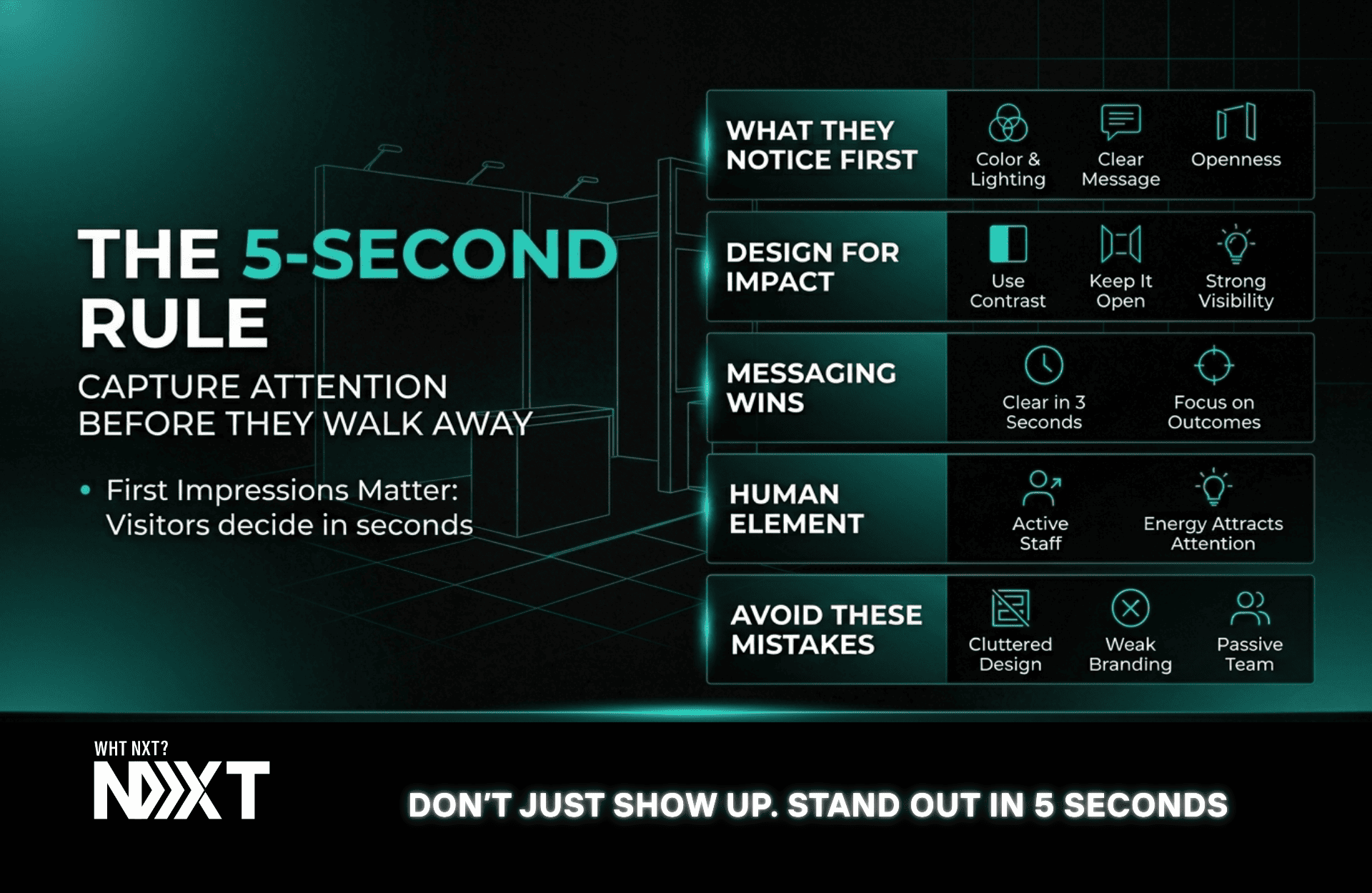
What does a visitor actually process in those first five seconds? It’s a lightning-fast hierarchy of perception:
- Color & Light: Is the booth inviting or dull? (Contrast wins over harmony).
- Scale: Does the exhibition booth design command the space?
- The "What": Does the headline clearly state the solution?
- The "Vibe": Does the staff look like they want to help, or are they hiding behind a counter?
Insight: Humans are biologically programmed to move toward light and open spaces. If your booth is dim or blocked by a reception desk, you are fighting human nature.
3. Designing for Instant Stopping Power
To attract visitors at exhibitions, your design must act as a visual speed bump.
- Height is Authority: Use high-level branding or hanging structures (where permitted) to be seen from 50 feet away. If you can’t go high, use vertical pillars to create a sense of stature.
- The Power of Contrast: If the exhibition hall is carpeted in grey and the walls are white, use bold, saturated brand colors. Don't blend in—clash strategically.
- Negative Space: A common booth design tip is to leave 40% of your floor space empty. A cluttered booth looks like work; an open booth looks like an invitation.
4. Messaging: The 3-Second Clarity Rule
By the third second, the visitor needs to know exactly what you do. If your main header is "Innovating for a Better Tomorrow," you’ve failed.
- Focus on the Outcome: Instead of "We Make High-Efficiency Pumps," try "Reduce Your Industrial Energy Costs by 30%."
- The 20-Foot Rule: Your primary value proposition should be legible from 20 feet away.
- Kill the Jargon: Save the technical specifications for the brochures. Use the walls for "the big win."
Pro Tip: Ask someone outside your industry to look at your stall design for three seconds. If they can’t tell you what you sell, go back to the drawing board.
5. The Human Element: Staff & Movement
Your trade show marketing is only as good as the people standing in the 6x8m space.
- The "Reception Desk" Trap: A desk acts as a physical and psychological barrier. Move your staff to the edges of the booth. They should be "active hosts," not "gatekeepers."
- Energy Attracts Energy: A booth where staff are talking to each other or looking at phones is a "dead zone." Movement—whether it’s a live demo, a digital screen, or staff engaging with a visitor—creates a magnet effect.
6. Common Mistakes That Kill Attention
- Over-Designing: Too many graphics create visual noise that the brain chooses to ignore.
- Passive Teams: Staff sitting down is the fastest way to ensure visitors keep walking.
- Weak Branding: If your logo is only at waist height, it disappears the moment three people stand in front of it.
- No Clear Entry Point: If a visitor isn't sure where to "step in," they won't.
The Verdict: Engineered for Impact
Winning at a trade show isn't about having the biggest budget; it's about having the sharpest exhibition engagement strategies. Great stalls are not designed to exist—they are designed to stop people.
When you stop viewing your stall as a "display" and start viewing it as a "conversion machine," you stop hoping for a crowd and start engineering one.
Is your next booth a gamble or a guaranteed ROI? Don't just show up—dominate. If you're ready to turn your "Concept into a Crowd," let's build something that stops the hall in its tracks.

Leave a comment
Your email address will not be published. Required fields are marked *