From Footfall to Fortune: How to Attract High‑Value Clients to Your Booth
Most exhibitors walk away from trade shows with a fishbowl full of business cards and a CRM packed with “window shoppers.”
They mistake noise for networking and footfall for fruitfulness.
But in the world of B2B marketing, a booth swarming with people isn’t a sign of success—it’s often a sign of poor targeting.
If you’re looking to attract decision‑makers at exhibitions, you have to stop designing for the crowd and start designing for the “C‑suite.”
High‑value clients don’t have time to browse; they are looking for solutions, authority, and efficiency.
Here’s how to shift your exhibition booth strategy from a passive display to a high‑intent magnet for top‑tier prospects.
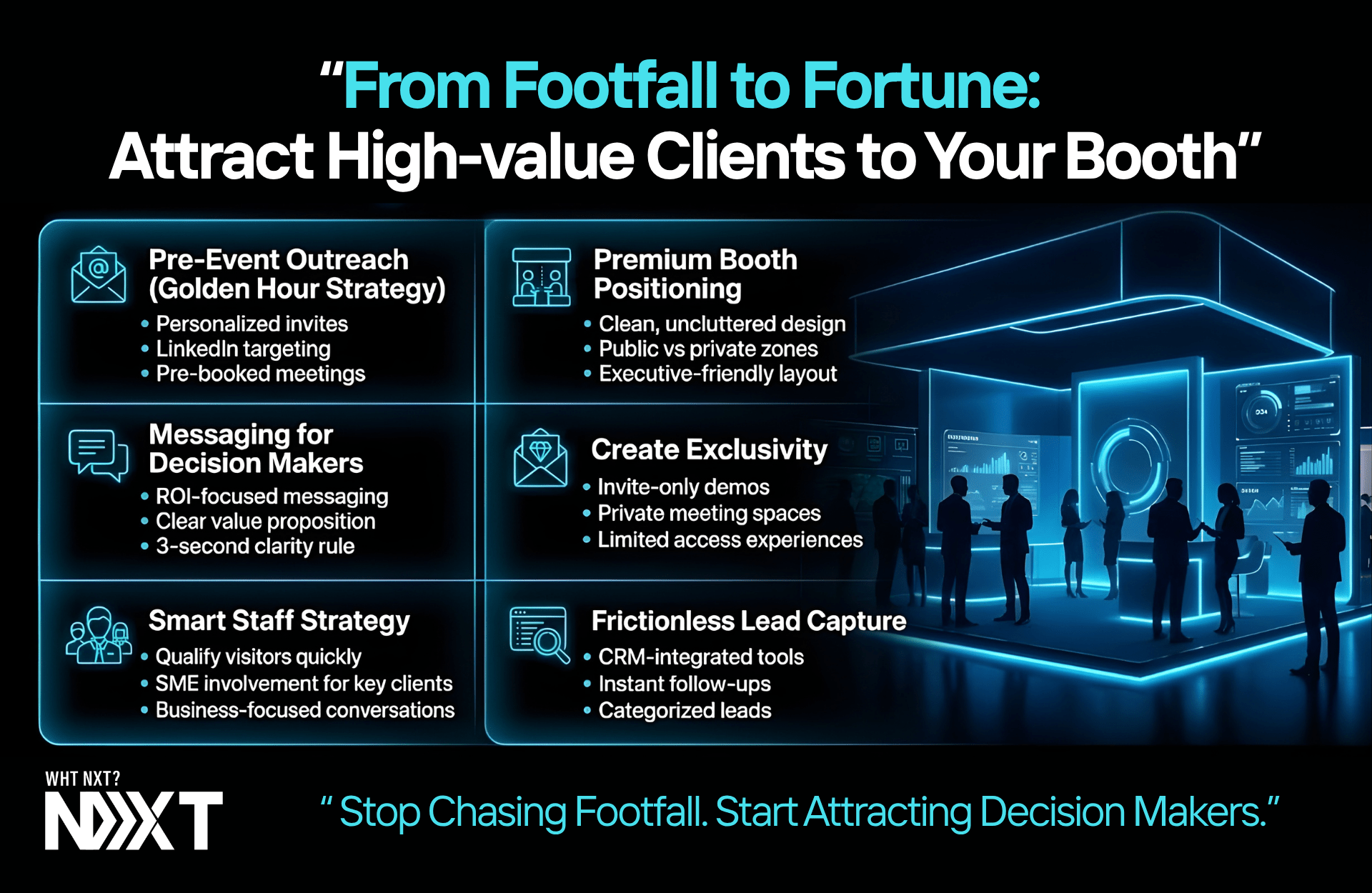
1. The “Golden Hour” Strategy: Pre‑Event Outreach
High‑value clients rarely “stumble” upon a booth and sign a deal.
Their itineraries are set weeks before the doors even open.
To secure their time, you must win the battle for their calendar.
What actually works in practice:
- Personalised Video Invites: Send a 30‑second video to your top 50 targets, calling out a specific problem in their business and showing how your solution at the show can help.
- LinkedIn Ad Retargeting: Run a narrow‑focus ad campaign targeting employees of specific high‑value accounts attending the event, with a clear call‑to‑action to book time.
- The VIP Calendar Link: Provide a direct booking link for a 15‑minute “Expert Consultation”—not a generic “demo”—so time feels protected and valuable.
Use the event’s hashtag and attendee list to identify key players.
Don’t just tell them to “stop by”; give them a concrete reason to meet, such as a first look at a proprietary industry report or a case study tied to their segment.
2. Positioning Your Booth for Premium Perception
In B2B lead generation events, your booth’s physical design acts as a silent filter.
If it looks like a bazaar, you’ll get bargain hunters.
If it looks like a lounge or a laboratory, you’ll get leaders.
Human‑centric design choices:
- The “De‑Clutter” Rule: High‑value clients are repelled by visual noise. Use clean lines, warm materials, and open spaces that feel more like a consulting room than a retail shop.
- Zoning: Divide your booth into “Public” and “Private” zones. Use a semi‑private seating area with higher‑quality finishes to signal that serious conversations happen here.
When executives walk in, they should feel treated like clients, not leads.
That subtle shift in atmosphere can quietly eliminate the casual visitors and keep the right people engaged.
3. Messaging That Speaks to Decision‑Makers
Generic slogans like “The Global Leader in X” mean nothing to a VP of Operations.
To attract high‑value clients at trade shows, your messaging must pivot from what you do to what you solve for their business.
Practical tweaks that make a difference:
- Focus on ROI and Scale: Instead of “We make fast software,” try “Reduce operational overhead by 22% within six months.”
- The “3‑Second Filter”: A decision‑maker should be able to look at your booth and know within three seconds if you’re relevant to their bottom line.
Your booth copy should feel like a short, sharp business case, not a brochure.
That’s how you stand out in the whirlwind of a crowded exhibition.
4. Create an Aura of Exclusivity
Human psychology dictates that we value what is gated.
Instead of offering a demo to anyone with a pulse, create a “Black Box” section or invite‑only experience.
Real‑world exclusivity tactics:
- In‑Booth Briefings: Host 10‑minute “Executive Briefings” at set times, limited to a small group.
- The “Hidden” Tech: Keep your most advanced prototype or software module behind a translucent screen or in a private room, accessible only via a scheduled appointment.
When prospects see that something is reserved for a few, they naturally assume it’s worth more.
This subconscious signal helps attract and retain the right audience around your booth.
5. Training Staff to “Qualify Up”
Your booth staff are the gatekeepers of your trade show marketing strategy.
If they spend 20 minutes talking to a student or a low‑level researcher, they are missing the CEO walking past.
Human‑driven qualification:
- The 60‑Second Pivot: Train staff to open with a higher‑level question: “What project are you currently overseeing?” rather than “How are you?”
- The Hand‑Off Protocol: Junior staff should handle initial scans and general questions, while Subject Matter Experts (SMEs) are reserved for high‑value prospects.
When every team member understands the difference between a visitor and a decision‑maker, your booth becomes a filtering machine, not a crowdsourced talking shop.
6. Implement “Frictionless” Lead Capture
Nothing kills a high‑value conversation faster than fumbling with a paper form or a glitchy scanner.
If the process feels clunky, so does your brand.
High‑intention lead capture:
- Real‑Time CRM Integration: Ensure your lead capture tool feeds directly into your CRM with custom tags such as “Hot Lead” or “Decision Maker.”
- The Immediate Follow‑Up: Use automation to send a “Nice to meet you” email while they’re still standing in your booth, reinforcing your team’s professionalism and efficiency.
When the experience feels smooth from the first handshake to the first email, decision‑makers begin to see you less as a vendor and more as a trusted partner.
Conclusion: Quality Is the Only Metric That Matters
Success at a trade show isn’t measured by the number of badges scanned, but by the depth of the relationships initiated.
By shifting your exhibition booth strategy from “mass appeal” to “targeted authority,” you transform your presence from a cost center into a high‑octane revenue driver.
High‑value clients aren’t looking for more “stuff”—they’re looking for partners who respect their time and understand their challenges.
When you build your event experience around those two pillars, the right people won’t just stop by; they’ll stay, engage, and move into your pipeline.
Ready to elevate your next event?
Let’s move beyond the standard display and engineer an environment designed for conversion, not clutter.
Reach out to discuss a bespoke strategy that positions your brand where it belongs: at the top of the industry.

एक टिप्पणी छोड़ें
आपका ईमेल पता प्रकाशित नहीं किया जाएगा। आवश्यक फ़ील्ड * से चिह्नित हैं