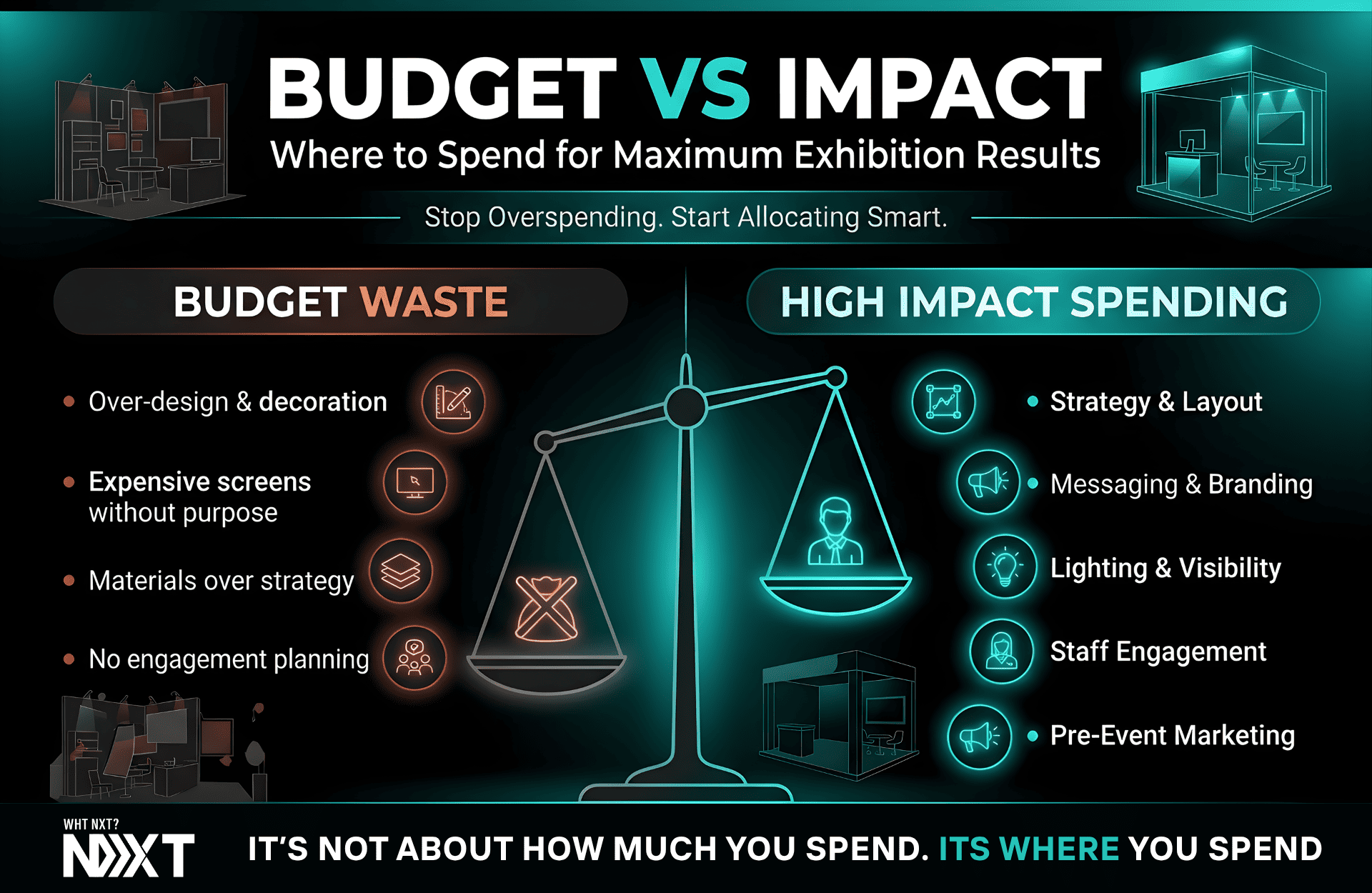
The biggest myth in the exhibition industry is that the company with the largest checkbook wins the show floor.
Every year, brands pour millions into massive, towering structures, believing that physical volume equals market authority. Yet, at the end of the three-day event, many of these "behemoths" walk away with nothing but a pile of generic business cards and a staggering bill.
The brutal truth? Higher budget does not equal better results. Impact is not something you purchase; it is something you engineer.
The Real Problem: Where the Money Goes to Die
Most exhibitors overspend in the wrong areas because they prioritize vanity over velocity. Budget is frequently wasted on:
- Over-Designed Stalls: Structures that are architecturally impressive but psychologically confusing to a visitor.
- Material Overload: Using expensive marble or high-end finishes that don't actually communicate your value proposition.
- Passive Tech: Large LED screens playing generic corporate videos that provide zero interaction.
Insight: If a visitor can’t tell what you do within three seconds, it doesn’t matter if your booth cost $10,000 or $100,000—you are invisible.
High-Impact Investment Areas: Where to Spend More
If you want to maximize your trade show ROI, you must shift your focus from "how it looks" to "how it performs." Here is where your money actually moves the needle:
1. Strategic Booth Design (Visitor Flow & Psychology)
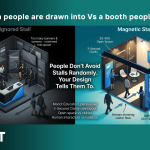
Don't pay for a "pretty" booth; pay for a data-driven layout. Spend your budget on a design that considers the "Journey & Magnet Points." An open, inviting layout that guides a visitor from an attraction point to a deep-dive conversation zone is worth far more than a closed-off, luxurious fortress.
2. Messaging & Outcome-Driven Branding
Your walls are not for your logo; they are for your solution. Invest in high-quality graphics that focus on client outcomes (e.g., "Reduce Downtime by 40%") rather than internal jargon.
Pro Tip: Spend on the 20-foot rule. Your primary value should be legible and clear from 20 feet away.
3. Lighting & Visibility
In a dimly lit hall, light is a biological magnet. Instead of expensive flooring, invest in high-CRI (Color Rendering Index) lighting and backlit fabrics. Strategic lighting can make a small, well-designed booth look more premium and "official" than a massive, shadowy neighbor.
4. Pre-Event Marketing
Maximum exhibition results start before the doors open. Allocate budget to reach out to your existing CRM and target LinkedIn prospects. If 50% of your meetings are pre-booked, your booth is already a success on Day 1.
Low-Impact Spending: Where to Cut
- Excessive Decorative Elements: If a design element doesn’t help a visitor understand your product or feel comfortable, delete it.
- Premium Materials without Purpose: Matte laminates and clean finishes often look more modern and "tech-forward" than expensive, heavy woods or stones.
- Unmanned Tech: If you have a screen, make it interactive. If it’s just a TV playing a loop, it’s a wasted asset.
The Practical Budget Allocation Framework
While every show is different, a smart exhibition marketing strategy typically follows this ROI-centric breakdown:
| Category | Allocation | Why? |
|---|---|---|
| Strategy & Design | 30% | This is the blueprint. Bad strategy ruins good fabrication. |
| Build & Fabrication | 25% | High-quality, clean execution. Don't overspend on "bulk." |
| Branding & Graphics | 20% | This is your primary communication tool. Never skimp here. |
| Engagement & Staff | 15% | Training your team to be "Active Hosts" rather than "Gatekeepers." |
| Pre/Post Marketing | 10% | Ensuring the right people show up and the leads don't go cold. |
The ROI Mindset Shift
To win, you must stop asking: “How will our stall look?”
And start asking: “How will our stall perform?”
- Performance is measured by the number of qualified conversations.
- Performance is measured by how many people stopped because of your "5-Second Hook."
- Performance is measured by the cost per lead (CPL) versus the lifetime value of a customer (LTV).
Common Mistakes to Avoid
- The "Structure Trap": Spending 90% of the budget on the physical booth and having $0 left for engagement or lead-capture tech.
- No Follow-Up Strategy: Collecting leads and waiting two weeks to call them. By then, the "impact" has faded.
- Ignoring the Human Factor: A $200,000 booth with a bored, phone-scrolling staff is a $0 ROI booth.
Conclusion: Impact is Engineered, Not Purchased
Smart budget allocation beats big budgets every single time. By focusing on visitor psychology, clear messaging, and pre-event engagement, you can outperform competitors with twice your spend.
At WhtNxt, we don’t just build booths; we engineer conversion machines. We help you identify the high-impact zones that drive real business results, ensuring your exhibition presence is an investment, not an expense.
Ready to rethink your exhibition approach? Let’s blueprint a strategy that prioritizes performance over vanity.
Explore Our Strategic Insights Blog | Schedule a High-Impact Consultation

एक टिप्पणी छोड़ें
आपका ईमेल पता प्रकाशित नहीं किया जाएगा। आवश्यक फ़ील्ड * से चिह्नित हैं