Walk down any trade show aisle and you will witness a stark, expensive dichotomy.
On one side, a booth is teeming with activity. Decision-makers are lining up, conversations are energetic, and badges are being scanned at a furious pace. Just ten feet away, an identically sized space sits in dead silence. Its staff stands awkwardly checking their phones, surrounded by premium materials, expensive catering, and absolutely zero audience.
In the exhibition world, empty space is the ultimate tax on a lack of strategy.
Crowded stalls are not an accident. They are not the result of luck, better luck of the draw in floor planning, or a more colorful logo. They are strategically engineered environments designed around human psychology and spatial intelligence.
Here is the anatomy of why some spaces dominate the floor while others fade into the background.
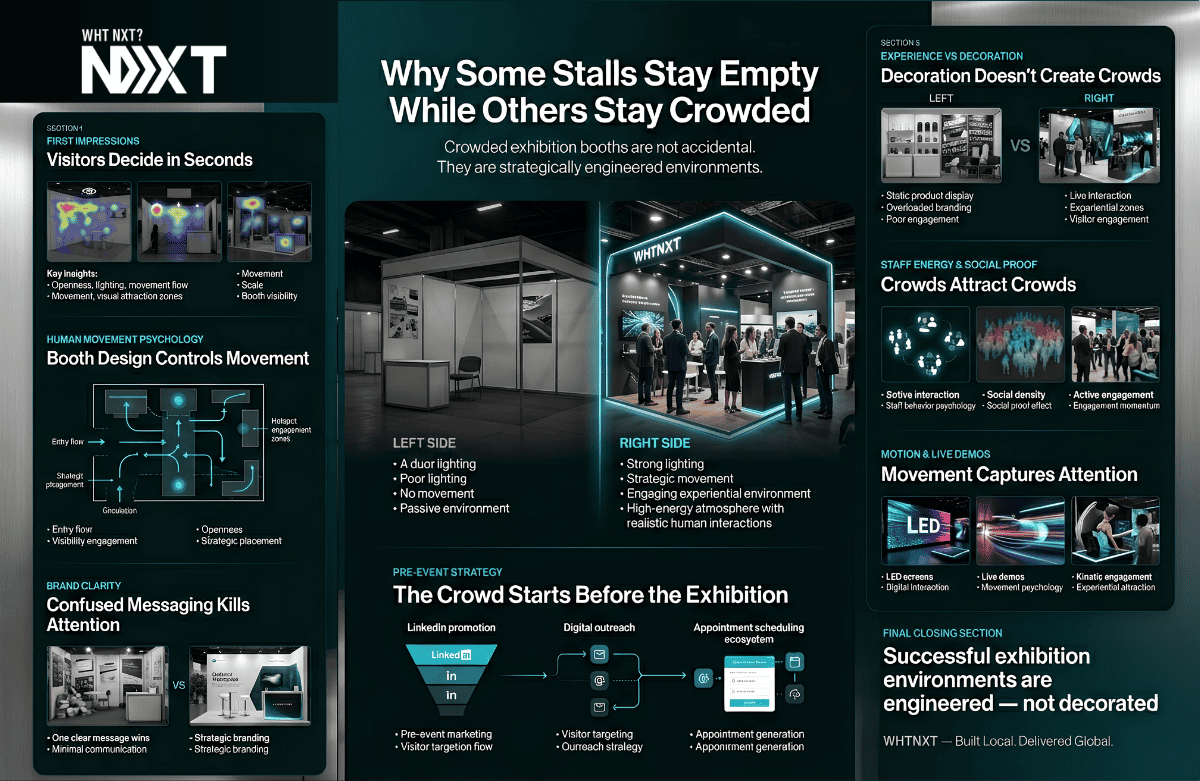
1. First Impressions: The Three-Second Filter
Before a visitor ever speaks to your sales team, they judge your brand. Human psychology dictates that this evaluation happens within three seconds of visual contact.
Empty stalls treat their space like a storage unit, cramming every product, brochure, and roll-up banner into the perimeter. The result is visual noise. When the human brain faces clutter, it experiences cognitive overload and instinctively moves away.
Crowded stalls operate on strict visual hierarchy:
- Scale and Lighting: They use dramatic, high-contrast lighting to guide the eye precisely where it needs to go, rather than washing the booth in generic, flat light.
- Controlled Movement: They incorporate subtle, deliberate motion—whether digital or mechanical—because the human eye is evolutionarily hardwired to track movement.
- Spatial Balance: They understand that negative space (empty space) is not wasted space; it is premium design that conveys authority and breathing room.
2. The Trap of Decoration vs. Experience
Most exhibitors design for beauty; market leaders design for behavior.
Unsuccessful booths are purely decorative. They feature beautiful graphics and static product displays, essentially functioning as a passive, three-dimensional catalog. They tell the visitor, "Look at what we made."
High-impact stalls focus entirely on engagement. They don't just display products; they build interactive zones and live demonstrations. They give visitors a physical or intellectual reason to pause. Movement creates energy, energy creates a crowd, and a crowd creates the most powerful marketing force on the trade show floor: social proof. People naturally want to see what everyone else is looking at.
[Static Decoration] ──> Passive Viewing ──> High Friction ──> Empty Stall
[Live Engagement] ──> Active Dwell Time ──> Social Proof ──> Crowded Stall
3. Spatial Psychology and the Control of Movement
The architecture of a booth dictates the behavior of the traffic passing it.
Empty stalls often feature psychological barriers. A massive counter placed right at the edge of the aisle acts as a physical wall, signaling to visitors that entry requires immediate commitment. High-walled, enclosed designs feel exclusive in the wrong way—they look dark, intimidating, and risky to step into.
Strategically crowded stalls utilize an open-flow architecture. They are highly accessible from multiple angles, offering clear visibility from a long distance. Product placement is deliberate: star innovations are positioned slightly inside the booth, acting as a visual anchor that pulls visitors off the main aisle and into the brand environment without forcing an uncomfortable initial greeting.
4. Clarity Over Complexity
Confused branding kills attention instantly. When an industrial brand tries to tell its entire fifty-year history, list fifteen product lines, and display twenty corporate values on a single fabric wall, the message is lost entirely.
Strong brands tell one clear story. They lead with a singular, high-impact value proposition that answers the visitor’s immediate question: What problem do you solve for me? Graphics are minimalist, copy is sharp, and the execution is premium. Clarity signals sophistication. Complexity signals desperation.
5. Staffing the Energy Frontier
The most brilliant design will fail if the human element inside it is passive.
We have all seen the empty booth syndrome: staff members clustered together in a circle, backs to the aisle, or sitting behind a desk looking at laptops. This body language creates an invisible "do not disturb" sign.
In crowded stalls, staff behavior is synchronized with the environment. They don't aggressively pounce on passersby; instead, they position themselves open to the floor, actively hosting the space. They understand that energy attracts energy.
6. The Event Starts Weeks Before the Doors Open
The brands that dominate trade fairs do not rely on foot traffic alone. They build momentum long before the exhibition doors open.
While empty stalls wait for the event organizers to deliver an audience, crowded stalls execute a rigorous pre-event marketing strategy. They utilize targeted LinkedIn promotion to reach key industry players, lock in specific meeting slots weeks in advance, and send personalized invitations to high-value prospects. By day one, their schedules are already fifty percent full. The crowd you see on the floor is simply the execution of a pre-planned script.
Premium Execution: The Ultimate Trust Accelerator
At a premium B2B or industrial trade show, your stall is the physical manifestation of your corporate capability. Substandard fabrication, visible seams, unstable structures, or poorly finished edges communicate a devastating message: We cut corners.
High-impact environments are built with exceptional material choices, flawless finishing, and precise execution. When a space feels solid, engineered, and immaculately balanced, that premium quality transfers directly to the perception of your products and services.
The Bottom Line
Exhibition success is never a lottery. An empty stall is the predictable result of treating a space as a passive billboard. A crowded stall is the engineered outcome of aligning human psychology with architectural intent.
At WHTNXT, we don’t just build exhibition stalls; we design high-conversion strategic environments. We blend deep visitor psychology, premium spatial architecture, and flawless fabrication to turn your space into an unforgettable brand destination.
WHTNXT. Built Local. Delivered Global.

Leave a comment
Your email address will not be published. Required fields are marked *